


Why Millimeters Matter in End‑of‑Line Efficiency
Production line efficiency is often associated with robot speed, cycle times, or conveyor throughput. However, true operational excellence extends far beyond the factory floor. The real efficiency test begins once the product leaves the line and enters the logistics chain.
Many manufacturers assume they are dispatching fully loaded trucks and containers. In practice, a signific
ant portion of transported volume is nothing more than air.
In logistics literature, this hidden inefficiency is known as Idleness. But can a packaging design change of just 5.5 millimeters really eliminate hundreds of truck trips per year?
This week at Optimak Academy, we analyze a compelling
academic case study by Samed & Umemoto (2019) that demonstrates why integrating Product Development (PDP) with logistics engineering is not optional—but essential.
Case Study Overview
A Logistics Deadlock in Soya Oil Production
The study examines a vertically integrated soya oil manufacturer managing the full value chain—from production to bottling and distribution.
In the As‑Is scenario, the company faced severe in efficiencies during palletizing and transportation, despite stable production performance.
Current Packaging Parameters
- Bottle Geometry: Cylindrical
- Height: 249 mm
- Diameter: 79 mm
- Secondary Packaging: 20 bottles per carton (5 × 4 matrix)
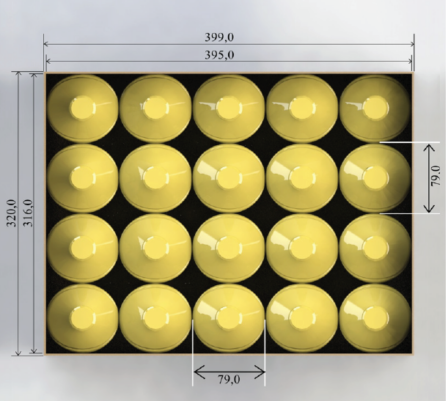

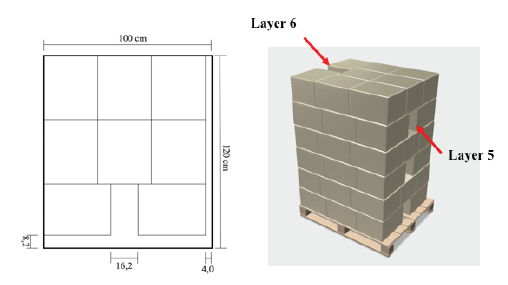
Identified Problem The pallet patterns generated using these dimensions resulted in large voids across the pallet surface. As a consequence, trucks reached their dimensional limits long before their weight limits.
Measured Impact
- Idleness Rate: 20.05% in 3‑axle trucks
- Interpretation: For every 5 dispatched trucks, 1 truck effectively transported air
Engineering Intervention
Data‑Driven Packaging Optimization
Rather than addressing the issue solely at the logistics level, the company involved Product Development Engineers alongside the logistics team.
Objective: Maintain a 1‑liter volume while redesigning bottle geometry to maximize pallet surface utilization.
Using mathematical modeling and simulation, multiple scenarios were evaluated. The optimal configuration—identified as Scenario 6—achieved a breakthrough.
Optimized Design Parameters
- Diameter Reduced: 79 mm → 73.5 mm
- Height Increased: 249 mm → 262 mm (volume preserved)
- Pallet Pattern: Braided (interlocked) layout


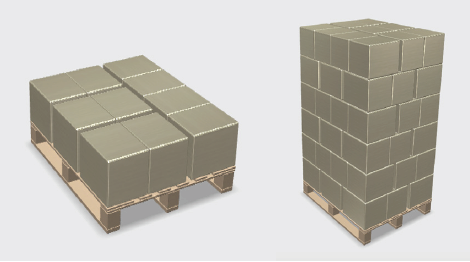
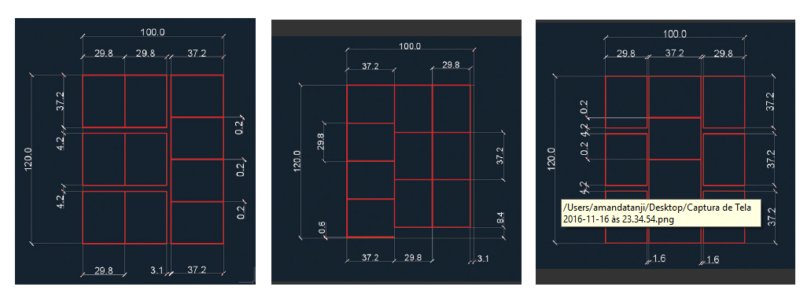
This new geometry enabled cartons to interlock across layers, increasing both stability and density.
Quantified Results
When Millimeters Reshape the Supply Chain
This seemingly minor design adjustment triggered a measurable butterfly effect throughout the logistics system.
Performance Gains
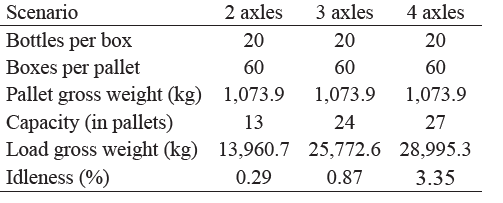
- Pallet Capacity: 48 → 60 cartons per pallet (+25%)
- Truck Idleness: ~20% → 0.87%
- Annual Trips (3‑axle trucks): 1,806 → 1,445
- Trips Eliminated: 361 fewer truck movements per year

Business & Sustainability Impact
- Significant reduction in freight costs
- Lower fuel consumption
- Meaningful decrease in CO₂ emissions
The fleet was no longer transporting air—it was transporting value.
Optimak Academy Perspective
End‑of‑Line Automation Starts with Design Integration
This study reinforces a core principle at Optimak STU:
Robotic palletizing efficiency is defined as much by product geometry as by robot speed.
Key Takeaways
- R&D and Logistics Must Collaborate
Packaging design should consider pallet, container, and truck optimization—not only shelf appearance. - Load Stability Is Non‑Negotiable
Braided pallet patterns significantly reduce collapse risk. Optimak’s robotic palletizing systems apply such patterns with millimetric precision. - ROI Thinking Beats Short‑Term Cost Avoidance
While changing a mold incurs cost, eliminating over 500 annual trips allows rapid amortization.
Increasing logistics efficiency isn’t about moving faster—it’s about loading smarter.
References
Samed, M. M. A., & Umemoto, A. L. T. (2019). An Oil Package Study Aiming the Logistics Optimization on the Palletizing Capacity. International Journal of Production Management and Engineering, 7(1), 13–21.

It is an amazing example of how the minor changes could improve efficiency especially in repetitive tasks. It shows that how it is important the collaboration between teams.